In this section
In this sectionCatalysing Capital: Creating the Investment Ecosystem for Energy Access in Fragile Settings
2026 marks a critical juncture. With displacement and humanitarian needs at historic highs and a systematic de-funding of the global response system—where 2025 funding dropped to 2015 levels despite displacement doubling—the humanitarian sector faces unprecedented pressure. Yet, within this challenge lies a vital opportunity to rethink how we deliver basic services.
Energy transitions in humanitarian settings are increasingly viable due to three key trends:
- Protracted Crises: Over 90% of humanitarian requests last year were protracted, demanding entirely new, long-term ways of working.
- Favourable Economics: Renewable energy has never been more economic, fueled by breakthroughs in battery storage and low PV costs, while fossil fuel prices skyrocket and availability fluctuates.
- Development Momentum: Major sector initiatives, such as Mission 300, are pushing large-scale investments into energy access as the premier engine for economic development and job creation across Africa.
This environment is forcing radical collaboration. Funding and staffing reductions are driving a sector-wide shift toward shared services. Electrification is well positioned to lead this charge: by using the energy access needs in longer-term protracted displacement settlements and larger loads - such as humanitarian facilities, water pumps, healthcare services, etc - as an anchor for wider rural industrialisation. If partners work together to aggregate demand, it is possible to reach the minimum ticket sizes required by Development Finance Institutions (DFIs) to build the complete Distributed Renewable Energy (DRE) capital stack needed in these more fragile locations.
From Pilots to Pipelines
Our core message is clear: the topic of sustainable energy access in displacement and fragile settings is maturing. It is time to move away from isolated, small-scale humanitarian projects toward large-scale, coordinated development plans using an ecosystem approach.
The GPA Secretariat convened a roundtable in February 2026 on the margins of the Humanitarian Finance Summit, co-hosted with Social Finance and Carbon Trust.
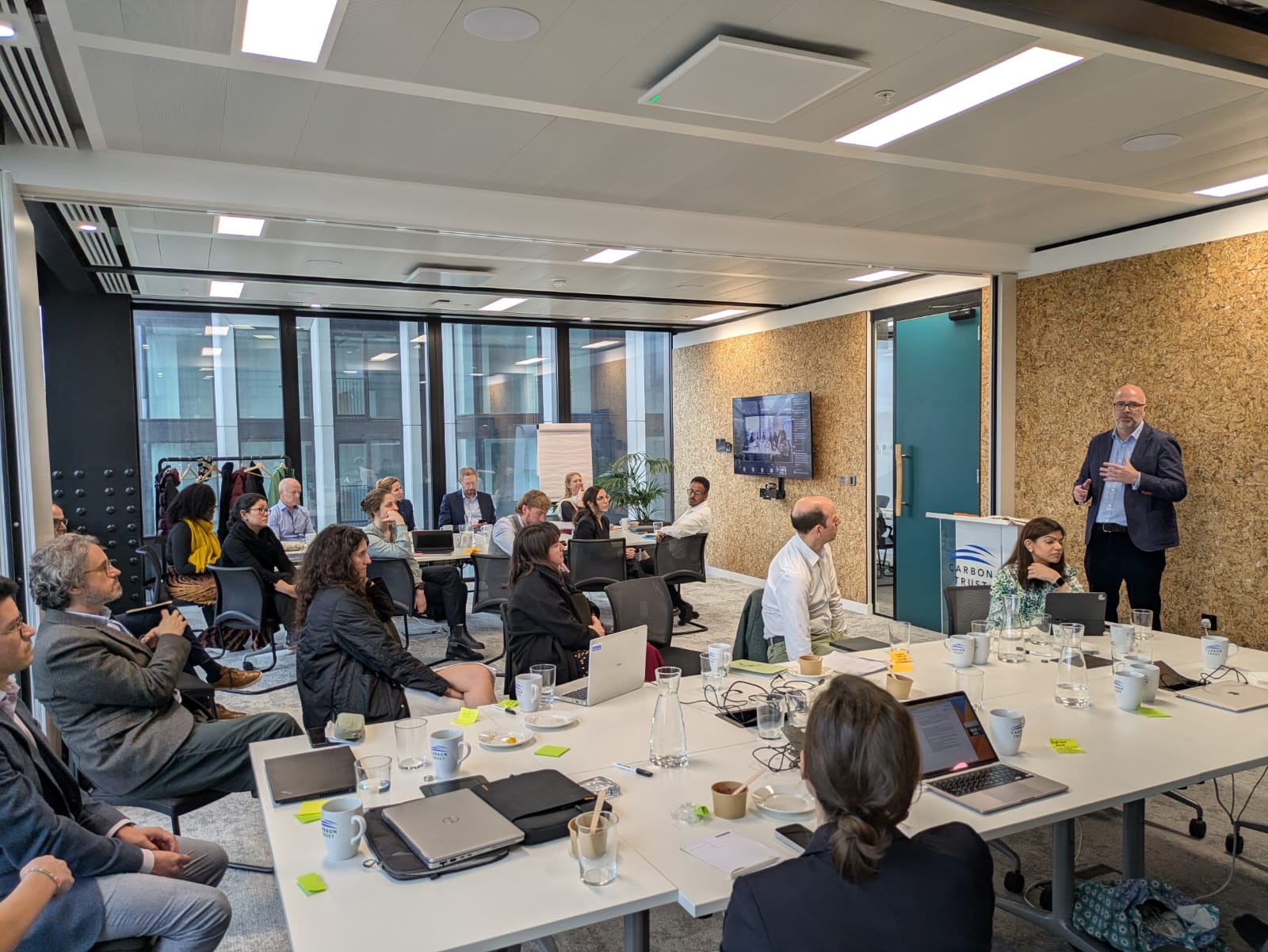
To catalyse this, the GPA Secretariat convened a roundtable in February 2026 on the margins of the Humanitarian Finance Summit, co-hosted with Social Finance and Carbon Trust. Exploring both demand and supply-side issues, key insights revealed that commercial finance alone remains unviable in fragility, conflict, and violence (FCV) settings. International investors typically avoid these regions due to perceived risks and a widespread lack of investor-ready project pipelines. To overcome these barriers, stakeholders recommended:
- Investors should support tailored blended finance and effective Technical Assistance to bridge the gap between commercial approaches and FCV contexts, investing directly in local ecosystems.
- Enterprises must undertake rigorous market validation and seek concessional financing to mitigate entry risks.
- Humanitarian Organizations should offer non-financial de-risking assistance to facilitate private-sector market entry.
Participants at the solutions ideation workshop in Nairobi in April 2026.
Co-Creating Solutions in Nairobi
Building on these insights, GPA convened a solutions ideation workshop in Nairobi in April 2026, bringing together a multi-sectoral group of government officials, investors, energy companies, and local refugee-led organisations. The focus was on co-creating actionable pathways to scale investment.
We established that there are opportunities for commercial viability when humanitarian agencies act as primary off-takers. Enabling humanitarian agencies to buy renewable-powered electricity through Energy as a Service contracts can save costs for humanitarian agencies, while recovering initial capital investments and ensuring long-term operations. We discussed other less profitable delivery models, such as electrifying health services, education, and local communities, which we determined require tailored blended finance models and ideally aggregation across locations to support economies of scale.
To transition this high-level strategy into on-the-ground reality, stakeholders aligned on four key actions to unpack and drive forward:
- Build Project Pipeline: Defining and packaging the energy access funding and investment opportunities more systematically to resource providers - this includes working directly with companies and investors on market entry into these contexts and structuring around different business models (e.g. UN/INGO generator replacement, local household and productive use loads, public institutions). Assessing potential to aggregate demand across opportunities.
- Convening, Advocacy & Matchmaking around M300: Using information from the market opportunity and project pipeline development exercise to convene, matchmake and advocate for channelling M300 financing to these opportunities. Advocacy should address procurement barriers within UN agencies that currently block Energy as a Service contracting models. GOGLA Off-grid Solar Forum and Expo (GOGSFE) 2026 can be used as a critical moment to conduct this advocacy.
- Local Area-Based Energy Masterplans: Developing and operationalising local area-based energy masterplans with local and national government leadership which transcend short budget and political timelines. The goal is to increase coordinated, actionable, locally grounded plans to be delivered by the private sector with enabling support from public sector actors (building on the momentum of the Shirika Plan and other similar inclusive policy frameworks) and deliberately shift these strategies away from "shopping lists" of disconnected projects and turning them into structured, bankable investment plans.
- Local Investing Supports: Increasing direct, intentional technical support to local and refugee-led micro enterprises to improve small-business investment readiness (e.g. financing/bookkeeping, business models, technology expertise, etc.). This includes expanding funding to deliver smaller ticket sizes by routing large donor capital through specialised local financial intermediaries capable of absorbing them. Furthermore, this requires high-level advocacy to operationalise refugee IDs to overcome rigid Know Your Customer (KYC) bottlenecks that currently block displaced people from accessing formal credit and PAYG technologies.
The time for isolated pilots is over; systemic, investable energy access in displacement and fragile settings is within reach. GPA will be taking these recommendations forward through targeted coalitions of partners - aiming to put in place the right information and investment opportunities to leverage the M300 and wider resources available - to make energy access for economic development in displacement and fragile settings a reality, at a larger scale than seen to date. The next meeting point to accelerate further action will be the GOGSFE, taking place in Kigali in October 2026.
To get involved and help shape these pipelines, please reach out to the GPA team via email.
The Global Platform for Action (GPA) in Sustainable Energy in Displacement Settings is the global initiative accelerating SDG 7 in forced displacement and fragile contexts. The GPA Secretariat, hosted at UNOPS, is advised by key humanitarian and development organisations, and supported by the IKEA Foundation and the European Union’s Civil Protection and Humanitarian Aid Operations (DG ECHO), with in-kind support from NORCAP and the UK Foreign, Commonwealth & Development Office (FCDO) through the Transforming Energy Access (TEA) platform.

Last updated: 18/06/2026