Event Details
4th March 2026
15:48 - 15:48 Geneva Time
A full HNPW programme agenda is available here.
Key Events
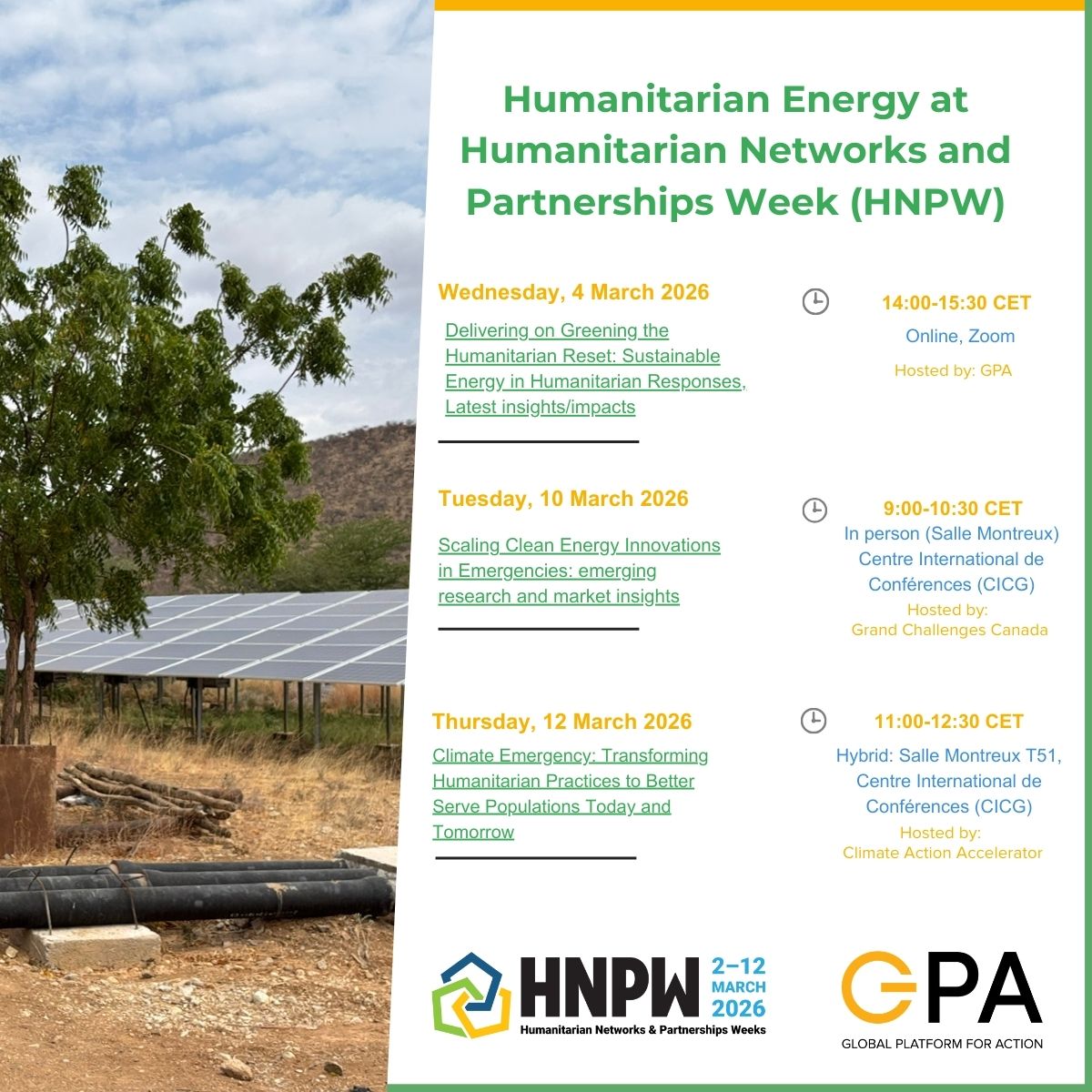
- Delivering on Greening the Humanitarian Reset: Sustainable Energy in Humanitarian Responses, Latest insights/impacts
- Date: Wednesday, 4 March 2026
- Place: Online
- Time: 14:00-15:30 Geneva Time
- Hosted by: GPA
-
Summary of the session
As part of HPNW 2026, this session brought together humanitarian actors, donors, NGOs, and GPA’s Network members to share the latest insights on scaling the transition of humanitarian operations to renewables and on public-private partnerships to achieve sustainable energy access in humanitarian contexts. Energy experts from humanitarian agencies, companies and local organisations shared their on-the-ground experience with innovative delivery models and discussed implications for the wider humanitarian sector in breakout rooms.
Clean Cooking Breakout room:
Both projects, the Results-Based Financing for Refugees (RBF4R) in the Mahama refugee camp, Rwanda, led by GIZ-EnDev and Practical Action Rwanda, and the e-cooking pilot in Sheder, Ethiopia, led by Mercy Corps, demonstrate that scaling clean cooking in displacement settings requires integrated approaches that combine energy infrastructure, consumer finance, supply-chain strengthening, and behaviour change. Technology pilots or incentive mechanisms alone are insufficient unless the broader market and institutional ecosystem are addressed. The SOLCO Climate Action Partnership, on the other hand, showcases a multi-stakeholder partnership approach that can help facilitate such ecosystem shifts. The Partnership is already working towards such goals in Rwanda, Uganda, Kenya and Nigeria.
Decarbonisation Breakout room:
The session highlighted strong interest and focus on practical approaches to decarbonisation, particularly in operations and maintenance, aligning with DG ECHO’s opening remarks. A key theme was the importance of capacity building and staff engagement. Successful implementation of solar systems depends not only on technology but also on staff buy-in across offices, facilities, and field operations. From a humanitarian perspective, participants emphasised the impact on communities, with examples such as IOM supporting multiple humanitarian hubs through solar energy. This demonstrates that diesel generators are not a sustainable long-term solution, both economically and environmentally.
Regarding financing and implementation models, there was scepticism about traditional long-term agreements and PPAs. Instead, service-based and leasing models were identified as more flexible and less risky alternatives, particularly for organisations managing assets globally.
A major gap identified was the lack of sector-wide data on cost savings. While solar systems are already generating significant savings, these are not being aggregated across the humanitarian sector. Better data collection and analysis could strengthen the case to donors by demonstrating the large-scale financial and environmental benefits of solar adoption.
- Scaling Clean Energy Innovations in Emergencies: emerging research and market insights
- Date: Tuesday, 10 March 2026
- Place: In person (Salle Montreux) Centre International de Conférences (CICG)
- Time: 09:00 -10:30 Geneva Time
- Hosted by: Humanitarian Grand Challenges
Last updated: 06/07/2026